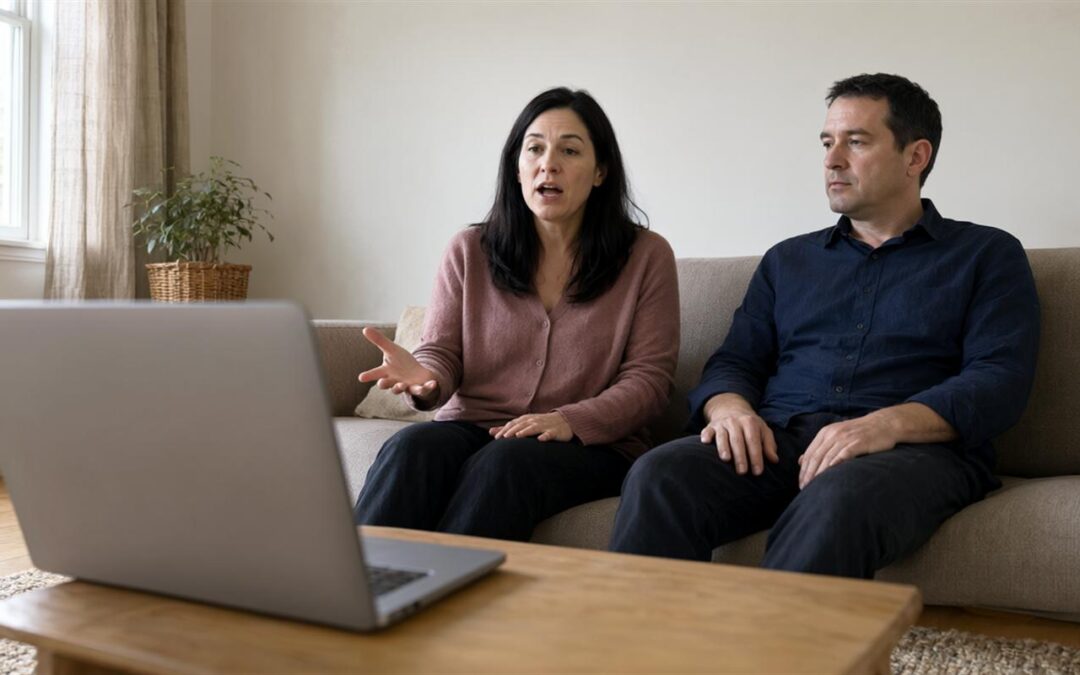
Two people can sit in the same room, open one laptop, and meet with a couples therapist who is not in the building. That is the whole premise of online couples therapy, and it raises practical questions before it raises anything else: where each partner sits, what the camera shows, and who speaks first when nobody can lean over.
This guide walks through the format itself — the setup, the turn-taking, the feedback — so you can picture a session before you book one. Healthy Relationships Counseling Services works with couples in Torrance and by secure video with clients across California, and the format sits alongside individual therapy, relationship therapy for one person, discernment counseling, and telehealth coaching. The room is different. The structure is not. If the whole idea of therapy through a screen is still new, what to expect from a first online therapy appointment covers that entry point in more detail.
What the Video Room Actually Looks Like
A couple ends up on a video call in one of two ways, and they are not equivalent. You can share one screen in one room, with the camera set far enough back that both faces are in frame. Or you can each join from a separate device, in the same house or in two different cities. A shared frame lets the therapist watch both of you at once, including the glance that passes between you when a subject lands. Separate connections give each partner more privacy and more uninterrupted room to speak, and they take that shared glance away.
Neither arrangement is the right one in general. What a therapist can work with depends on what the camera is pointed at, so the setup is worth deciding before the appointment rather than during it. Video sessions here are not an in-person meeting with a webcam switched on; telehealth coaching and therapy is a service in its own right, built around the remote format rather than adapted to it.
Setting the Room Up Before the Session Starts
Set the camera at eye level, not below the chin. Prop the device on a table instead of holding it, because a laptop or phone held in a lap moves with every shift in posture and turns the whole session into a slightly unsteady shot. If you are sharing one screen, check before the call that both faces are visible from where you plan to sit — the most common surprise in a first session is a partner who has been out of frame the entire time.
Tell the rest of the household that the room is occupied, and put the phone somewhere it will not buzz. If you are joining from two locations, agree in advance that either of you can ask for a pause without it being a verdict on the conversation. A dropped connection can be rejoined, so a rough plan for that is worth thirty seconds of thought. None of this is a rule of the practice. It is simply what makes a room usable when the room is also your home.
How Turn-Taking Works When Nobody Can Lean Over
Relational Life Therapy slows a conversation down on purpose. The model reads the relationship as a practice rather than a verdict, built moment by moment, a little at a time. In a slowed conversation, one partner speaks while the other listens, and the two jobs are not the same job. The Speaker stays with their own experience instead of arguing the case. The Listener stays present without interrupting, correcting, or drafting a reply. Each partner practices both roles, and most people find one of them far harder than the other.
In online couples therapy, the hand-off has to be spoken. Nobody can lean over, and a silence with a screen in the middle of it reads as a technical problem rather than as listening. So the therapist names who holds which role and moves the floor explicitly. That can sound mechanical at first. After a few sessions it tends to become the rhythm of the conversation, which is the point of practicing it.
The habit that undoes this format is the phone. A device face up on the table pulls attention down and away from the person beside you, and a therapist watching two faces can see it happen in real time. Turning it over and leaving it out of reach is not required. It is one small way to protect the time you have both set aside.
What the Therapist Can and Cannot See
Video carries more than people expect. Pace, tone, who answers first, who looks away when a particular subject comes up — all of that arrives clearly through a screen, and it is much of what a couples therapist is tracking during a session anyway.
What does not arrive is the rest of the room. Posture, a hand on a knee, the way one partner turns toward or away from the other: some of it sits outside the frame, and some of it is too small for a webcam to catch. So the therapist asks rather than assumes. If you go quiet on a call, expect a question about it rather than a conclusion drawn from it.
How Progress Gets Checked Between Two Screens
Feedback-informed treatment is how this practice keeps track of whether the work is landing. Two short measures run every session: the Outcome Rating Scale at the start, on how things have gone since the last meeting, and the Session Rating Scale at the end, on whether the session gave you what you needed. Neither takes more than 30 seconds.
Both partners answer, and the answers routinely differ. One person can leave a session feeling heard while the other leaves feeling managed, and that gap is useful information rather than a failure. It gives the therapist something concrete to adjust before frustration sets in. The measures work the same way on a video call as they do in a room, which matters when a couple is deciding whether remote sessions are a fair substitute for being there in person. How feedback-informed treatment works in relationship counseling goes further into how the two scores shape the next session.
When Online Couples Therapy Fits and When It Does Not
The format fits when both partners can meet in a private space with a connection good enough to hear each other. It suits couples whose schedules are already full, one partner who travels, two people living in different parts of California, and anyone who would not otherwise agree to sit in an office. There is also something to be said for ending a hard conversation at home instead of driving across town afterward with it still in the air.
It does not fit every situation. If someone in the home is not safe, a video session is not the right container for that moment; emergency services and local crisis lines are the appropriate first contact, and a therapist can work on safety planning once things are steady. The format is also a poor fit when one partner will not join at all, when there is no room in the house where a conversation cannot be overheard, or when the connection is too unreliable to follow a sentence. Those are practical limits, not reasons the relationship cannot be worked on.
The Work Itself Does Not Change
The structure of the work is the same on video as in a room. The first task is an accurate picture: what works, the patterned ways the two of you interact, both of your realities, and where the couple is stuck. Then what each of you wants from the work, which is not always the same thing. Then a compelling vision for the relationship and a non-binding agreement of at least 12 to 16 weeks, with a plan attached to it.
The model behind that structure is Relational Life Therapy, developed by Terrence Real. Bonnie Kennan, Psy.D., MFT is trained through the Relational Life Institute, is a Master Certified Relational Life Therapist, holds LMFT 38442, and is a Certified Group Psychotherapist. Relational Life Therapy for couples sets out the service itself, and what happens in a Relational Life Therapy couples session walks through the sequence inside a session. The screen changes where the session happens. It does not change what the session is for.
Questions Worth Asking Before Booking
Four questions are worth asking before a first appointment. How will the video room be set up — one shared screen or two devices? What happens if the connection drops in the middle of a difficult stretch, and how does the session get picked back up? Will both partners be present from the first session, or does one partner start alone? And how does the therapist collect feedback when a session is not landing well?
Ask them plainly. A practice that does this work remotely will answer without hesitation, and the answers tell you something about how sessions will run before the first one is over. If an answer is vague, that vagueness is worth noticing.
A Practical Next Step
The practice sees couples working on the relationship together, one partner starting alone, and couples deciding whether the relationship continues through discernment counseling. Those options are available in person in Torrance and by video across California, and the choice between them can be talked through rather than guessed at.
A free consultation is the low-pressure version of a first step: a conversation about what has been happening and what kind of support fits, with no commitment to booking anything afterward. Request a free consultation when you are ready, and say plainly what you are unsure about. The contact page carries a request form and a book-a-session option, and the uncertainty you arrive with is usually the right place to begin.
Key Takeaways
- The video room comes in two shapes, either a shared screen in one room or a separate connection for each partner, and the choice changes what the therapist can see.
- Camera height, a steady surface, and a household that knows not to interrupt do more for a session than any other preparation.
- Slowed conversations depend on spoken hand-offs, because a screen cannot carry a look or an elbow.
- Two short feedback measures, one at the start and one at the end, show whether both partners are getting what they need from the process.
- Remote sessions are a poor fit when safety, privacy, or a usable connection is missing, and that is worth naming early rather than after several appointments.