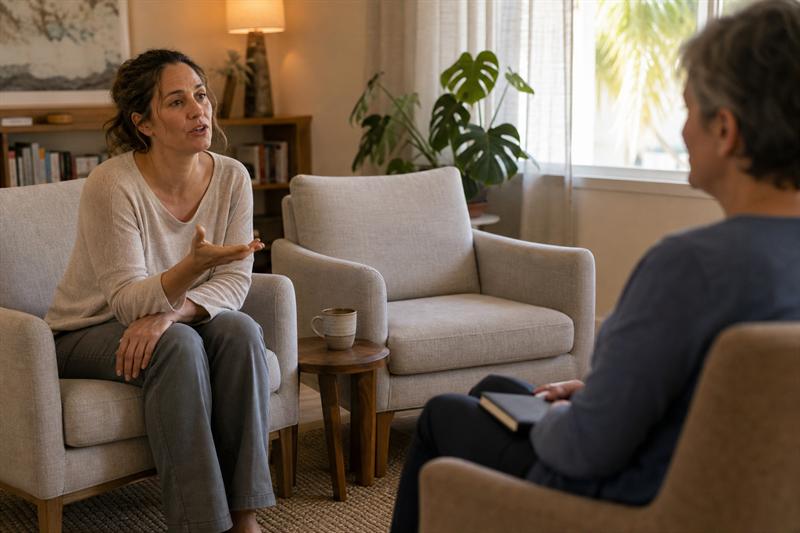
Quick Answer: Relationship therapy for one person is individual therapy focused on the relationship patterns, reactions, boundaries, and choices within your control when the other person is not in the room. It cannot make your partner change or place the whole relationship on your shoulders, but it can give you a structured way to understand what keeps happening and decide what needs to change next.
If you have suggested couples therapy and heard “no,” or if difficult conversations keep ending the same way, it makes sense to question whether going alone is worth it. At Healthy Relationships Counseling Services, the work begins with a clearer question than “Who is the problem?”: What pattern is happening, what part of it is within your control, and what does that mean for the relationship?
What Does Relationship Therapy for One Person Focus On?
Individual relationship therapy focuses on your experience within an important relationship. That can include a spouse or partner, a dating relationship, a parent, an adult child, a sibling, a friend, or an ex-partner when ongoing contact or unresolved dynamics still affect your life.
Relationship distress is rarely limited to one argument. A common pattern is that one person raises a concern, the other becomes defensive or distant, and the first person pushes harder or shuts down. The conversation ends without resolution, and both people may enter the next interaction already expecting conflict. Over time, that pattern can make the relationship feel stuck.
- Your emotional reactions during conflict
- The assumptions you make about silence, criticism, distance, or defensiveness
- Communication habits that cause conversations to go off track
- Boundaries you struggle to set, maintain, or respect
- Repeated choices that leave you resentful, disconnected, or unheard
- Your needs, values, and decisions about the relationship
Looking at Your Role Without Taking All the Blame
Looking at your role does not mean accepting blame for everything that has happened. It means identifying what you do when a pattern begins, what you continue to tolerate after it repeats, and what you may need to do differently to avoid getting pulled into the same cycle.
For example, someone may realize they keep explaining a concern long after the other person has stopped listening. That insight does not excuse dismissive behavior. It identifies an actionable choice: pause the conversation, state a boundary, or stop trying to force resolution when the discussion is no longer productive.
People sometimes arrive feeling certain that the other person is the entire problem. Another person’s behavior may be hurtful, dismissive, or controlling. Still, understanding your role in a relationship pattern can help separate what is yours to address from what is not yours to carry.
What Happens in Individual Relationship Therapy?
Relationship therapy for one person goes beyond retelling the latest fight. The work examines the cycle underneath the conflict, explores what happens inside you while that cycle unfolds, and builds skills for responding with more clarity.
Identify the Recurring Relationship Pattern
The first step is often slowing down a familiar interaction. One person brings up a concern. The other person gets defensive, changes the subject, or withdraws. The first person raises their voice, keeps pursuing the conversation, or gives up entirely. Both leave feeling unheard.
People can become focused on the argument topic, such as money, chores, parenting, or time together, while the more persistent issue is the sequence that happens whenever a difficult topic appears. If that sequence remains unnamed, the same conflict can return under a different subject.
Explore What Happens Beneath the Conflict
Arguments are influenced by more than the words being said. Therapy may explore the emotions, fears, assumptions, and learned responses that appear before you criticize, avoid, overexplain, people-please, or shut down.
For instance, a delayed text may lead one person to feel unimportant, while the other experiences follow-up questions as pressure. Neither reaction defines the whole relationship, but both can shape what happens next. Seeing that chain more clearly creates room to respond rather than react automatically.
Practice New Skills, Boundaries, and Responses
Insight alone does not always change a familiar pattern. Individual relationship therapy can include practical work on how to:
- Bring up a concern before frustration turns into criticism
- Notice emotional escalation early and pause before saying something damaging
- Communicate needs directly rather than expecting the other person to guess
- Set limits around disrespectful, circular, or unproductive conversations
- Make a repair attempt after conflict when repair is appropriate
- Make relationship decisions based on patterns over time rather than one intense moment
Conflict is often harder to resolve when people keep trying to solve it while emotionally flooded. A calmer response does not guarantee the other person will respond well, but it can make the pattern easier to see and give you a clearer basis for deciding what to do next.
Check Whether the Work Is Addressing the Right Goals
At Healthy Relationships Counseling Services, relationship work combines skills-based relational life therapy with feedback-informed treatment. The work includes regular attention to whether sessions are addressing the goals that brought you in and whether the approach feels useful.
That feedback matters because relationship concerns can shift. A person may begin therapy wanting to stop arguments, then realize the more urgent issue is setting boundaries, deciding whether trust can be rebuilt, or understanding why they repeat the same relationship dynamic.
When Is Relationship Therapy for One Person a Good Fit?
Relationship therapy for one person can be a practical option when you need help with a relationship but joint sessions are not possible, appropriate, or desired. It can also be useful when the same painful dynamic appears across more than one relationship.
- Your partner, spouse, family member, or friend refuses therapy.
- You keep having the same argument and nothing changes after the conflict ends.
- You feel emotionally distant, resentful, overly responsible, or unable to speak up.
- You notice people-pleasing, overfunctioning, withdrawal, or intense pursuit across relationships.
- You need clarity before making a significant relationship decision.
- You are in couples therapy but need separate space to work on your own reactions, boundaries, or goals.
When you feel as though you are carrying the emotional work for two people, waiting for the other person to become ready can keep you stuck. Individual support may be worth considering when you recognize these signs:
- You rehearse conversations for hours but still leave them feeling unheard.
- You avoid raising concerns because every discussion becomes an argument.
- You keep changing your approach, but the relationship returns to the same cycle.
- You no longer know what is reasonable to ask for or what limit you need to set.
When these signs are present, the issue may be more than one difficult conversation. The relationship pattern may need direct attention.
Relationship Therapy for One Person vs. Couples Therapy vs. Discernment Counseling
The best type of support depends on who is willing to participate, what is happening in the relationship, and what you need to decide. Individual relationship therapy is often a practical starting point when you are the only person ready to begin.
Relationship Therapy for One Person
One person attends, and the focus stays on that person’s experience, patterns, emotional responses, boundaries, skills, and decisions. This approach can fit when the other person will not attend, when the relationship involves someone other than a partner, or when you need individual clarity before deciding what comes next.
Couples Therapy
Couples therapy involves both partners when both are willing and it is appropriate to work together. The focus is the interaction between partners: how conflict develops, how each person responds, what blocks repair, and what both people are prepared to change.
Couples therapy is not automatically the better option simply because the problem exists between two people. It requires participation from both people. When one person does not want to engage, individual relationship therapy gives the willing person a productive place to start.
Discernment Counseling
Discernment counseling may fit when one or both partners are unsure whether to continue the relationship or try couples therapy. The goal is not to force a decision. It is to clarify what has happened, what each person is willing to examine, and whether there is enough shared commitment to attempt relationship repair.
If uncertainty about staying or leaving is the central issue, discernment counseling for couples deciding next steps may be more relevant than standard couples work.
Relationship Coaching
Relationship coaching and therapy can address different needs. Coaching may focus on goals, skills, and accountability, while therapy can provide space to address relationship distress, emotional reactions, and patterns affecting daily life. The important distinction is the actual problem being addressed, not the label that sounds most appealing.
What If Your Partner Refuses Couples Therapy?
If your partner refuses couples therapy, you can still begin work on the relationship questions you are carrying. A refusal does not automatically mean the relationship is over, but it does reveal an important fact: you cannot build a joint therapy process by yourself.
Individual relationship therapy can help you stop organizing your next step around whether the other person changes their mind. You can work on communication planning, emotional regulation, boundaries, recurring patterns, and the decisions you may need to make if the current dynamic continues.
Repeated pleading, persuading, or threatening can turn therapy itself into another source of conflict. When your partner refuses couples therapy, a more useful question is not how to force participation. It is what you need in order to respond clearly to the relationship as it is.
Individual therapy cannot make another person attend, communicate honestly, or change their behavior. If there is fear, coercion, violence, or immediate danger, standard relationship therapy alone is generally not the right response. Safety and specialized support need to come first.
What Relationship Therapy for One Person Cannot Do
Clear limits make this service easier to understand. Individual relationship therapy is not a way to diagnose an absent partner, prove who is right, or guarantee a specific outcome.
- It cannot provide a full assessment of someone who is not participating in therapy.
- It cannot compel another person to change, communicate, attend sessions, or remain in the relationship.
- It cannot guarantee reconciliation, resolution, or renewed trust.
- It does not require you to accept responsibility for another person’s actions.
- Broader individual therapy may also be useful when anxiety, depression, grief, substance use, trauma, or difficulties managing emotions are strongly affecting the relationship.
Ignoring these limits can lead people to measure therapy by the wrong standard. The purpose is not to control the other person. It is to understand your position in the pattern and act with more clarity.
How Healthy Relationships Counseling Services Approaches Individual Relationship Work
Healthy Relationships Counseling Services approaches individual relationship work as both a relational and practical process. Sessions examine the pattern you are living in, then connect that understanding to skills you can use in real conversations and decisions.
The work may include emotional regulation, clearer communication, boundary setting, recognizing escalation, and learning how to respond when another person becomes dismissive, distant, critical, or unwilling to engage. This is not generic advice to “communicate better.” It focuses on identifying what breaks down in your specific pattern and which response may change the next part of that cycle.
Feedback-informed treatment adds another layer of accountability. If the work is not helping you address the concern that brought you in, that information belongs in therapy. Progress is reviewed through your experience of whether the goals, focus, and approach remain relevant.
Healthy Relationships Counseling Services provides individual relationship support in Torrance and offers telehealth coaching where appropriate. The central question remains the same in either setting: What is happening in the relationship, what is within your control, and what needs to change in your response?
How to Decide Whether to Start Relationship Therapy on Your Own
Start by identifying the issue that feels most repetitive or most costly. Do not begin with the goal of making someone else understand you. Begin with the goal of understanding the pattern clearly enough to know what you need to do next.
- What relationship situation is taking up the most emotional energy?
- What have you already tried, and what keeps returning?
- Do you need help communicating, managing your reactions, setting limits, or making a decision?
- What are you still waiting for the other person to do before you take your own next step?
If you are seeing the same cycle despite changing the topic, timing, or wording, the pattern itself may need attention. Starting therapy alone can be a practical step when waiting has become the main strategy and is no longer changing anything.
Key Takeaways
- Relationship therapy for one person is individual therapy centered on relationship patterns, experiences, skills, and choices.
- It can be a useful starting point when a partner or other important person will not participate in therapy.
- The work can support insight and relational skills without requiring the client to take all responsibility for the relationship.
- It cannot control another person’s actions or guarantee a particular relationship outcome.
Conclusion: Support for the Relationship Questions You Are Carrying Alone
The challenge is not simply that your partner, family member, or friend is not in the room. It is that the same relationship pattern may keep shaping your life while you are left trying to solve it alone. When that pattern goes unaddressed, resentment can grow, conversations may become more guarded, and important decisions may be delayed.
Healthy Relationships Counseling Services offers relationship therapy for one person to help you understand the cycle, strengthen the skills that can change your response, and clarify what you need from the relationship moving forward. Explore relationship therapy for one person and take your next step based on the pattern you are actually living with, not only on the change you hope someone else will make.
Frequently Asked Questions
Can relationship therapy work if only one person goes?
Yes. One person can examine the relationship patterns they participate in, including how they communicate, react, set boundaries, and make decisions. For example, someone who always pursues a conversation after the other person withdraws can learn to recognize the escalation earlier and respond differently. Therapy cannot make the other person change, but it can help the client avoid being trapped in the same automatic response.
What do you talk about in relationship therapy for one person?
Sessions may cover recurring conflict, emotional triggers, communication habits, boundaries, needs, assumptions, and major relationship decisions. The focus is usually not limited to the most recent fight. A therapist can help identify what happened before the conflict, how you responded, what you felt, and why the same outcome may keep returning.
Is relationship therapy for one person the same as couples therapy?
No. Couples therapy involves both partners and focuses on their shared interaction. Relationship therapy for one person focuses on the attending client’s experience, patterns, skills, and choices. The distinction matters when one partner refuses to attend or when the client needs individual clarity before joint work would be useful.
What should I do if my partner refuses couples therapy?
You can begin individual relationship therapy instead of waiting indefinitely for the other person to agree. The work can help you understand the pattern, decide what boundaries are needed, and clarify what you will do if the relationship stays the same. A partner’s refusal does not answer every question about the future, but it does show that your next step cannot depend entirely on their participation.
Does going to therapy alone mean I am the problem in the relationship?
No. Going to therapy alone means you are willing to look at the situation and your own choices within it. Personal accountability is not the same as accepting blame. You may learn to state a boundary more directly while still recognizing that the other person is responsible for whether they respect it.
When is individual relationship therapy not enough?
Individual therapy may not be enough when immediate safety, coercion, violence, crisis needs, significant substance use, or serious mental health symptoms are the main concern. It also cannot replace an assessment of someone who is not attending therapy. In those situations, the priority may shift from improving the relationship pattern to addressing safety, stabilization, or the specific concern affecting the relationship.